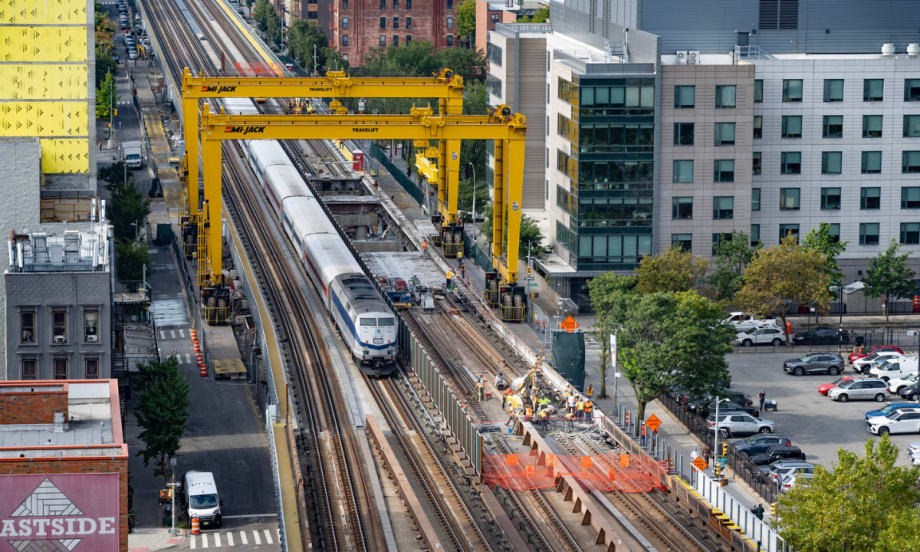
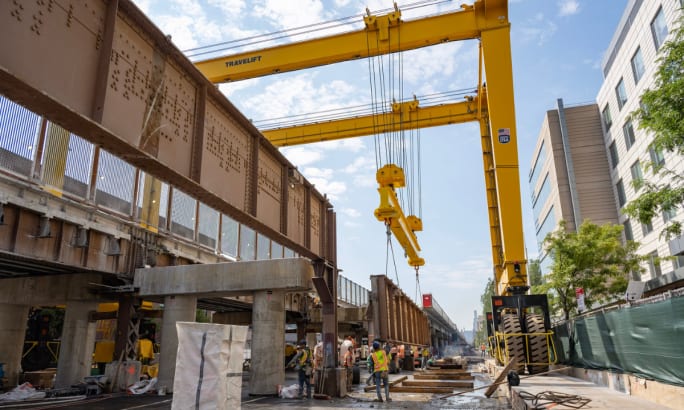
Crews use an innovative gantry system to install new prefabricated bridge units over Park Avenue, replacing 128 sections of the Metro-North Viaduct without disrupting service.
Photo: MTA/Trent Reeves
3 min to read
The Metropolitan Transportation Authority reached a major milestone with the completion of bridge replacement work on Phase 1 of the Park Avenue Viaduct Replacement Project. Through 128 bridge installations, the project replaced 8,240 track feet of the aging 132-year-old structure without disrupting Metro-North service.
According to an agency release, "strong" project management and an "innovative" construction approach have pushed the project as a whole $93 million under budget and 51 months ahead of schedule.
Ad Loading...
"[The] milestone demonstrates the transformative work we can get done in New York when we invest in transit," Governor Kathy Hochul said. "The Park Avenue viaduct is a lifeline for hundreds of thousands of Metro-North riders, and now, riders will benefit from a more reliable ride for decades to come."
MTA Upgrades 1890s Park Avenue Viaduct
The Park Avenue Viaduct is the elevated structure in East Harlem that carries four Metro-North tracks and approximately 98% of Metro-North trains daily. Without it, Metro-North would not be able to provide service to Manhattan for riders from the Bronx, Westchester, Putnam, and Dutchess counties, or the state of Connecticut.
It was constructed in the 1890s, and significant portions of it require comprehensive reconstruction after well over a century of heavy use.
"Completing work on an elevated structure that dates back to the Gilded Age ahead of schedule and under budget shows what's possible when we modernize our infrastructure and put riders first," Hochul said.
Crews work along Park Avenue in East Harlem as part of the MTA’s multi-phase effort to modernize the Metro-North Viaduct.
Photo: MTA/Trent Reeves
Phase 1 commenced in October 2023 to replace the full substructure and superstructure from East 115th Street to East 123rd Street along Park Avenue, as well as to install new track, power, communications, and signal systems across the new section.
Ad Loading...
Using an innovative gantry system erected over the Viaduct and spanning Park Avenue, the project was able to replace whole sections of the existing concrete and steel bridge deck with new prefabricated bridge units. Over 19 weekends since June 2024, the project replaced 128 individual sections of track — without disrupting Metro-North service on the other side of the structure.
Construction Approach Propels Harlem Viaduct Project Forward
Project contractor Halmar International proposed this approach during an extensive Design-Build procurement process following industry engagement. Phase 1 of the project is 21 months ahead of its initial schedule. This efficiency enabled the project to proceed simultaneously with Phase 2, from East 127th Street to the mid-block between East 131st Street and East 132nd Street, which commenced in May 2024.
Proceeding with Phase 2 on an accelerated timeline resulted in additional time savings, totaling 51 months compared to the initial baseline. As reported, the project is $93 million under its initial budget.
"Our 2025-2029 Capital Plan is all about bringing infrastructure into the 21st century, and we look forward to bringing the same innovative and cost-saving approach that has succeeded here to projects all over the system," MTA Chair and CEO Janno Lieber said.
While the entire structure for Phase 1 is now complete, additional work on the systems and track level will continue through the winter, with Phase 1 expected to reach substantial completion in April 2026. Progress on Phase 2 will continue apace, with substantial completion for that phase expected in September 2027.
Ad Loading...
Additionally, as part of the project, MTA Arts & Design commissioned a permanent art installation over 116 St and along Park Avenue. Harlem Melodic Moments, by Jorge Luis Rodríguez, depicts the music of Harlem and El Barrio on each façade through a visual rhythm of concentric interlocking rings. Large-scale medallions outlined in gold showcase performers of Salsa, Bolero, Latin Jazz, Jazz, Blues, Gospel, Be-Bop, Hip-Hop, Rap, and other danceable fusion genres.
"This replacement project strengthens the backbone of Metro-North's operations, which carries over 98% of all mainline trains. Ensuring the structural integrity and safety of the viaduct is critical to keep running safe and reliable service to and from Grand Central Terminal," Metro-North Railroad President Justin Vonashek said.
The agreement restores full commuter rail service after a three-day shutdown disrupted travel for hundreds of thousands of riders across the New York region.
Following its 2024 acquisition, ENC is upgrading operations, expanding capacity, and aligning its approach to meet agency demand for reliability and on-time delivery. METRO spoke to John Obert, vice president of transit sales, to find out more.
Officials said the ridership gains recorded in February, March, and April signal renewed public confidence in transit and reinforce AC Transit’s vital role in connecting East Bay residents with jobs, schools, healthcare, shopping, and recreational destinations.
A new study found commuters in several major U.S. cities could save hundreds of dollars each month by taking public transit instead of driving, with Los Angeles ranking as the nation’s most expensive city for car commuters.
HDR’s transit program management lead discusses the challenges of overseeing large capital projects, adapting to cost and supply chain pressures, and the capabilities agencies need to build for the future.
Over the three days, PRT recorded 485,000 rides, reflecting the extraordinary number of trips taken as people traveled throughout the region for Draft events, work, and daily life.
Garo Hovnanian explores how agencies can better navigate competing priorities, strengthen decision-making, and prepare for a future shaped by electrification and emerging mobility.
The plan includes investments in cleaner vehicles and upgraded stations, NJT LiveView to provide real-time GPS tracking of train and light rail service, enhanced safety initiatives through a new Real Time Crime Center, and the debut of a redesigned NJ TRANSIT mobile app.
ABQ RIDE Forward is the first transit system overhaul in more than 25 years. This latest phase marks 15% completion of the 16-phase rollout, which will continue over the next several years.