




Take a Look: The Buses at APTA Mobility 23
How Transit Agencies View the Workforce Shortage
The American Public Transportation Association followed up the first phase of its workforce shortage study by examining how workers and agencies view the issue. The association, along with transit agencies, discussed the outlook of the workforce shortage and more.
June 9, 2023
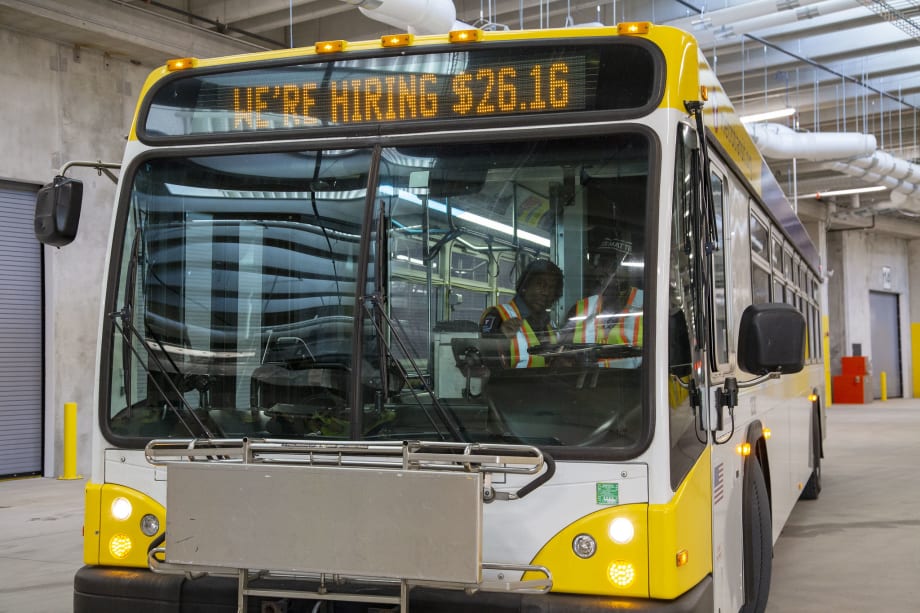
Metro Transit held a hiring event that more than 150 people attended and were able to drive a vehicle through a safe course.
Photo: Metro Transit
10 min to read
Transit workers and agencies are now weighing in on the workforce shortage in the latest findings from the American Public Transportation Association’s study "Transit Workforce Shortage: Root Causes, Potential Solutions, and the Road Ahead.”
In Phase 2 of the study, APTA received responses from 190 agencies about what they believe are the causes of the shortage. Additionally, the association received responses from more than 1,300 current and former transit workers about the workforce shortage.
APTA explains the findings from Phase 2 were to build upon what was learned in Phase 1, which showed there were possible gaps in communication on the workers’ views of the shortage versus what agencies thought the issues were.
The main findings from the workers’ perspective include:
Pay, work schedule, and agency responsiveness are seen as key to retaining and attracting workers. According to current transit workers, increasing pay and providing better work schedules are the most effective ways to retain employees.
Half of current transit workers believe their benefits are competitive with previous jobs; this number drops for those working at the largest transit agencies and among former workers. Although current transit workers believe benefits are competitive, only 36% of the workers feel their pay is competitive with similar jobs in their area. At the top 50 agencies by ridership, this figure is only 32%, according to the study. Meanwhile, 44% of former workers felt their pay was competitive.
Transit workers and agency management have different understandings of the pressures on operations workers. Operations workers and agency management both ranked assault and harassment lower among reasons for quitting. However, current, and especially former workers, ranked it substantially higher than the agency management respondents.
Rather than reacting to workers’ concerns, transit agencies, such as Central Ohio Transit Authority (COTA) and Metro Transit, are being proactive in recruiting and retaining bus operators.
What Do Agencies Believe Caused the Shortage?
APTA collected responses from agencies across the U.S. in the second phase of the study, and these are the findings:
The transit workforce shortage is widespread and severe. Ninety-six percent of agencies surveyed reported experiencing a workforce shortage, 84% of which said the shortage affects their ability to provide service.
Transit agencies face intense competition for workers. Applicants reject transit agencies’ employment offers 35% of the time — more than twice the rate for jobs across all industries. Agencies reported that more departing employees leave to take jobs outside the transit industry than those who retire or leave the workforce combined.
Agencies report that concerns about work schedules and compensation are leading reasons why workers quit. Most agencies said that concerns about work schedule and compensation were responsible for more departures than assault and harassment or concern about contracting COVID-19; those concerns are leading to more departures than before the pandemic began.
A complex regulatory framework is hampering agencies’ ability to fill vacancies. Rules about drug and alcohol testing, Commercial Driver’s License (CDL) requirements, criminal background checks, and driving records extend the hiring process and exclude otherwise qualified applicants.
Jeff Pullin, director of Public & Media Relations at COTA, factors in the COVID-19 pandemic as a cause for the shortage.
“During the pandemic, Baby Boomers continued to retire and older Generation X employees are reaching retirement as well,” Pullin says. “It was more difficult to hire and train employees during the days of social distancing.”
APTA’s study finds that “the transit workforce is aging and will experience a high retirement rate for the foreseeable future.”
“One of the main findings of the outside research is that a large percentage of transit operations workers are over 55, higher than in the broader transportation sector,” says Matthew Dickens, APTA’s director of Policy Development and Research. “This means the industry will see a high retirement rate in the coming years. This makes it even more important for agencies and the industry to build robust recruiting pipelines, and to work to build agency culture and morale to retain existing workers.”
Forty-three percent of transit workers are over 55, according to the report. Agencies also report that 24% of quitting workers are retirements; this is true at 34% of rural agencies.
“The pandemic also has changed people’s priorities, especially among younger generations,” Pullin says. “Many are looking for more work-life balance, better work hours, and steady schedules, all of which are difficult to provide in transit operations. Organizations must adapt to those needs as best as they can to attract and retain frontline employees.”
Minneapolis’ Metro Transit also felt the impact of the COVID-19 pandemic.
“Once COVID started, we had a big adjustment in service levels,” says Brian Funk, COO at Metro Transit. “We paused hiring for nine months because we were severely overstaffed at that point. We're continuing to float along and figure out when our demand is going to return and how we will be responsive.”

In the past year, COTA has raised its operator training wages twice.
Photo: COTA
How Agencies Responded to the Shortage
APTA held interviews with transit agency staff that revealed a world in which transit agencies and their current and prospective employees work together to address the labor shortage.
The study shows agencies generally have an understanding of why they are struggling to hire or retain workers. COTA and Metro Transit provided examples of what they are doing to respond to the issue that aligns with the themes found in the study.
According to APTA, themes among agencies’ solutions include:
Recruiting
Hiring
Training and onboarding
Working conditions and policies
Building culture and improving morale
“Some of the most impactful initiatives have come in the areas of recruiting and hiring,” says Dickens. “Many agencies told our researchers about how they created partnerships in their communities to improve recruitment efforts, and streamlined hiring processes so they did not lose potential hires to other opportunities.”
APTA’s report highlights how COTA has tackled the problem of schedule improvement through the creation of the Schedule Modernization Team (SMT).
“COTA’s Schedule Modernization Team was developed from the organization’s strategic plan under the guiding principle of achieving organizational excellence,” Pullin says. “Before this effort, bidding was more of a manual process and time-consuming for scheduling staff and operators.”
In 2021, COTA converted an in-person, on-paper process to online work bidding for operators.
Eventually, this program will be able to show work assignments to alleviate the need to call the division desk to get same-day or next-day work assignments.
The tool is also capable of PTO request handling, though COTA says this hasn’t been implemented yet.
“Online bidding helped manage needed safety protocols during COVID by enabling operators to bid remotely and added flexibility on when and where operators can bid,” Pullin says. “Emphasis is now on understanding how to provide a better work-life balance for current operators and ultimately promote it when hiring future operators.”
In the past year, COTA has raised its operator training wages twice. The agency is also offering $2,000 signing bonuses for new operators and $2,500 signing bonuses if the new hire already has a CDL-B license.
COTA has also begun offering medical, dental, and vision benefits to domestic partners of employees.
“We changed our policy to now allow benefits to kick in within the first month of employment,” Pullin says. “We are now offering to help pay employees’ student loans, providing a $100 monthly stipend, and we are also exploring more benefits for employees who are starting a family or growing theirs.”
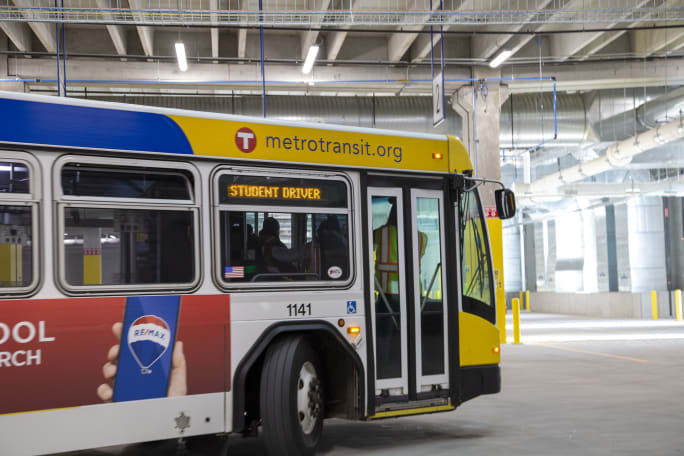
Metro Transit is doing internal work on creating a positive work environment with a path to promotion and ongoing training.
Photo: Metro Transit
Metro Transit Addresses Workforce Shortage
Metro Transit has had a similar response to COTA, as one of the ways the agency combated the challenges was with increased compensation.
“We've compressed our step progression for operators from a seven-year progression down to five. That provided immediate relief, where we went from just under $22 an hour, starting, to over $26 an hour, starting,” Funk says. “That put us back in a competitive market locally and even nationally. “
Metro Transit also did a two-pronged approach where it changed to a $5,000 signing bonus for people who start and already have their commercial driver’s license. Everyone else is at a $3,000 signing bonus. And then the agency also implemented a referral bonus of $3,000 per candidate for all staff who are not directly involved in the hiring process.
The APTA survey reveals that agencies find employee referrals and online advertising are the two most effective forms of recruiting.
Funk mentions Metro Transit is doing internal work on creating a positive work environment with a path to promotion and ongoing training. The agency is also actively working on retention.
The agency eliminated the high school diploma GED requirement. Metro Transit has first-generation or new citizens in the U.S. who are having a hard time finding documentation from their home countries. The job has a lot of technical skills that can be evaluated. Funk says the agency will make a determination on the applicant’s fit and ability to perform the job, so it has set that aside.
Metro Transit has an ad that promotes how certain criminal convictions don't immediately bar anyone from employment and that they're evaluated more on a case-by-case basis.
“We've eased our application process and eliminated a bunch of unnecessary fields to try to speed up the background review,” Funk says.
Another change is that Metro Transit has started to make conditional offers, even for people who do not yet have their commercial learner's permit.
“What we've started to do is we bring people and call it ‘week zero.’ It's the week leading up to week one of training,” Funk says. “You're getting paid the full starting wage, and we have you in a classroom going through the chapters with an instructor and taking practice quizzes so that you're preparing to be able to get that commercial learner's permit you need before you start official training.”
Other agencies struggle to attract applicants with CDL permits, according to the APTA study. For example, St. Cloud Metro Bus developed a training program that begins with the permit written test and allows for an accelerated timeline.
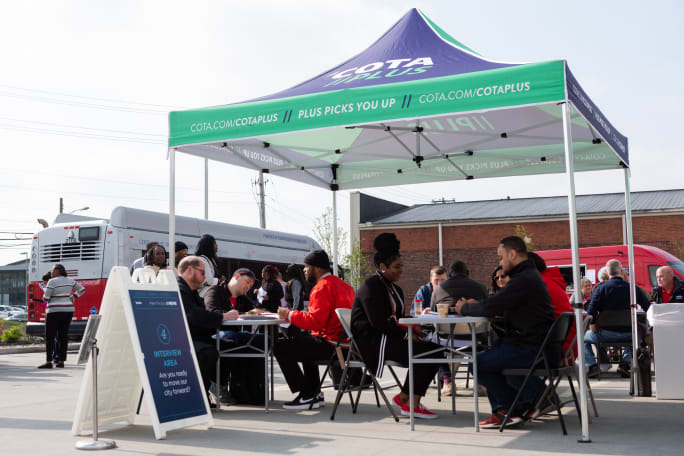
COTA recently hosted a hiring event to allow candidates to get a closer look at what it is like to be an operator.
Photo: COTA
COTA, Metro Transit Hiring Events
COTA and Metro Transit held hiring events where participants were able to take control of the wheel.
COTA recently hosted a hiring event to allow candidates to get a closer look at what it is like to be an operator. Nearly 200 candidates were able to sit in the driver’s seat, hear from operators, learn about benefits and wages, apply and interview on the spot, and possibly receive a job offer the same day.
“It was incredibly successful in boosting our new hires and showed the Central Ohio community that the workforce is our number one priority,” Pullin says.
Metro Transit also had a hiring event that more than 150 people attended and were able to drive a vehicle through a safe course.
“People can envision themselves in the role,” Funk says. “It's one thing to see somebody who looks like you in an advertisement, but we all need to be doing a good job of making sure people can see themselves in the seat. Nothing beats actually getting behind the wheel and knowing how to engage it.”
These initiatives from COTA and Metro Transit reflect what the agencies interviewed in the APTA study are focusing on. The report found agencies are working to increase the number of new workers and increase worker retention.
Outlook of the Workforce Shortage
APTA’s study provides lessons from its interview with both the workers and agencies.
Compensation and schedules dominate workers’ decisions to stay or quit transit work.
Even so, workers make employment decisions based on a complicated mix of factors.
Agencies must work to accommodate the changing needs and preferences of the transit workforce.
Collective bargaining agreements can be modified in ways that serve the interests of both agencies and workers.
“At COTA, we hope we are currently seeing a turning point in our workforce challenges, but we believe this national trend will take a few more years to solve,” Pullin says. “Central Ohio is rapidly growing, with a million more people expected to live and work here by 2050. We must be innovative in our hiring and scheduling processes to attract more employees and retain talent.”
Funk is also hopeful Metro Transit can navigate through the workforce shortage and continue to improve its efforts.
“We're going to make use of all of this energy and effort and then hopefully continue to leverage those internal resources, like the referral bonus, to continue to promote and bring people into our apprenticeship program,” Funk says. “We don't have a region that's experiencing explosive growth. We haven't seen a huge shift in the unemployment rate or big layoffs from similar firms in our region.”
For other agencies that need help recruiting and retaining operators, Pullin offers a piece of advice.
“Agencies need to closely examine their procedures and ensure there are no barriers to the hiring, training, and onboarding processes,” he says. “Understand that CDL positions are in high demand — so where can your agency stand out among the others? What incentives or benefits can be provided to ensure they are keeping good talent and hiring more.”
Subscribe to Our Newsletter
More Management

METRO Opens Submissions for 2026 Motorcoach Awards
Nominations are now being accepted for METRO Magazine’s Operator of the Year and Innovative Operator of the Year awards.
Read More →
New York MTA Advances Final Contract for Second Avenue Subway Expansion
Contract Four is the largest in the Second Avenue Subway Phase 2 project and includes construction of station infrastructure, tracks, and signals for the subway expansion, MTA officials said. Work on Contract Four will begin in 2027.
Read More →
Transit Agencies Highlight Safety Gains at National Summit
Leaders from 15 major transit systems shared crime-reduction results and safety initiatives while discussing the role of continued federal support.
Read More →

NITA Names New Leadership, Expands Reduced-Fare Program at First Board Meeting
The new regional transit authority appointed its first board chair and interim executive director while extending reduced fares across CTA, Metra, and Pace for eligible riders.
Read More →
Beyond the Checklist: A Structured Approach to Transit Maintenance
Reliability-Centered Maintenance helps transit agencies move beyond routine checklists to focus limited resources on the assets and failures that have the greatest impact on safety, reliability, and service.
Read More →
APTA 2026 Nominating Committee Selects Leadership Slate, Names Chair and Vice Chair Nominees
Leadership changes will help shape the association’s priorities and its representation of the transportation industry during the 2026–2027 term.
Read More →
DART Launches Major Security, Fare Enforcement Initiative
The 90-day demonstration will deploy coordinated security teams at five light rail stations while testing controlled access and gathering data to guide future investments.
Read More →
Sponsored•September 9, 2026
Advancing Fare Collection Through Technology and Innovation
Learn about delivering 1300 gates at 91 stations while managing fare evasion. Explore the large scale deployment, solution customization and real-world results that affect the region. Prepare for deployment in your region now.
Read More →
Game Day in Motion: Moving Millions During the 2026 World Cup
Between packed transit stations and team motorcoaches, see how agencies and operators across North America tackled the transportation demands of the 2026 FIFA World Cup.
Read More →
Surface Transportation Extension Averts Shutdown, Leaves Transit Funding Gap
The stopgap keeps federal transportation programs moving, but missing advance funding could complicate the transit and rail projects agencies are planning next.
Read More →