Valley Metro has navigated the ongoing workforce shortage, COVID-19 pandemic, and other issues during a time when it changed leadership. In March 2022, Jessica Mefford-Miller was named CEO of the agency and has now openly stated where she sees Valley Metro going from here.
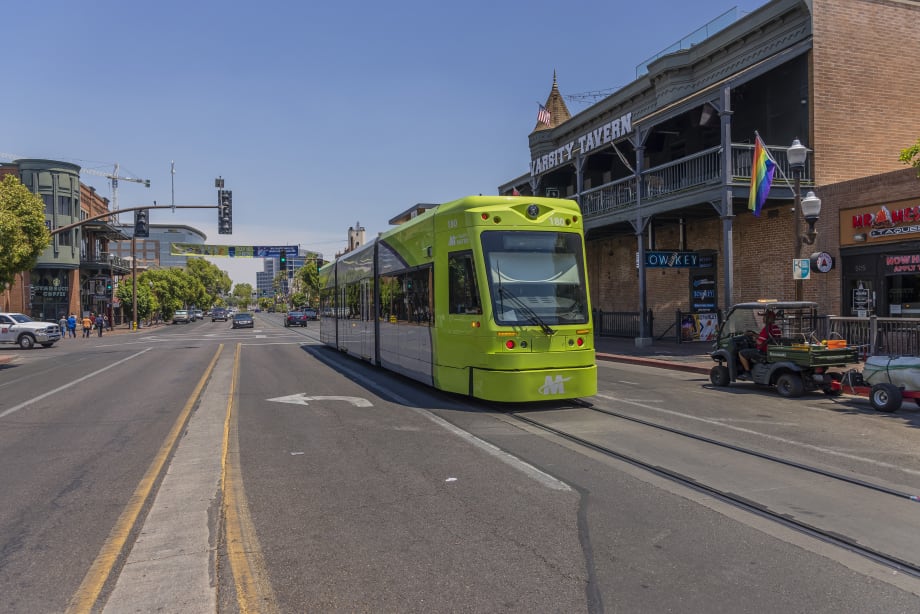
Valley Metro’s streetcar service in Tempe, Ariz., opened in May 2022, not long after Jessica Mefford-Miller took over as CEO.
Photo: Valley Metro
8 min to read
Valley Metro was founded in 1985 and now serves approximately 34 million riders annually.
Photo: Valley Metro
Valley Metro, the public transit agency serving the Phoenix metropolitan area, underwent the biggest change any company can make in March 2022, but that hasn’t stopped it from making a difference in the community.
In March 2022, the agency named Jessica Mefford-Miller as its new CEO, following the retirement of Scott Smith in the spring of 2022.
Ad Loading...
Despite the change at the top, the agency is pushing forward with its zero-emissions goals, Tempe streetcar service, and more.
Jessica Mefford-Miller
Photo: Valley Metro
Jessica Mefford-Miller’s Vision for Valley Metro
Mefford-Miller has more than 15 years of experience connecting people and places through transit in the St. Louis region. She has now been the leader of Valley Metro for more than a year and is still seeking the best for the agency’s riders.
“My vision for Valley Metro is that we will deliver excellent customer experiences by becoming more connected to our communities, developing our talent within our organization, leveraging data and technology, and creating a safer more secure transit environment,” Mefford-Miller says.
She adds that Valley Metro is developing and growing its team so that it can “deliver the world-class transit system that our fast-growing region needs and deserves.”
The agency is continuing to deliver a large capital expansion program, including planned streetcar and light rail extensions.
Ad Loading...
“In the year ahead, we are exploring changes to our service plan that will create opportunities to deliver more productive, reliable, and relevant on-street service — things like increased frequency on some of our busiest corridors, expanding microtransit, and expanding the deployment of autonomous vehicles,” Mefford-Miller says.
Mefford-Miller mentions the greatest challenge in the year ahead is securing the continuance of a regional funding stream for transportation infrastructure and service, including transit.
“Earlier this year, the Arizona Legislature passed and Governor signed legislation that will enable a ballot question to be presented to voters in Maricopa County in 2024,” explains Mefford-Miller. “If successful, this initiative will extend a transportation sales tax that has been in place for nearly 40 years. For transit, this means the continuance of funding that enables Valley Metro to connect communities and enhance lives across the fifth largest city, and fastest-growing county in the U.S.”
Mefford-Miller admits that the COVID-19 pandemic played a role in the early part of her tenure.
“I arrived at Valley Metro just as the country was moving out of the worst of the pandemic, yet the impacts were especially acute,” she explains. “We experienced a tremendous workforce shortage that prevented us from delivering service as planned, which had ripple effects across the workforces we support throughout the metro Phoenix region.”
Ad Loading...
However, with the support of its boards of directors, Valley Metro was able to work with its contractors in security, bus, rail, and paratransit operations to increase pay and offer signing bonuses that have been important in supporting hiring and retaining its frontline staff.
Valley Metro’s CNG, Zero-Emissions Efforts
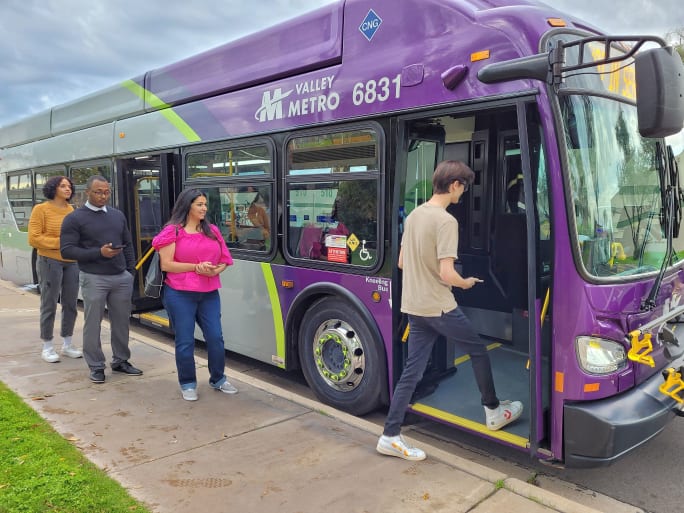
In June 2023, the Federal Transit Administration (FTA) awarded Valley Metro with a Low-No Emission grant to incorporate 40-foot battery-electric buses into the current fleet. The grant included charging stations, bus facility upgrades, and workforce development.
With a mandatory local match from the regional Prop. 400 funds of $2.1 million, the FTA awarded Valley Metro $13.3 million for fleet replacement and charging infrastructure.
According to the agency, the goal of the program is to support the transition of the nation’s public transit fleet to more energy-efficient and cleaner vehicles.
The grant will allow the purchase of 20 battery-electric buses and 12 chargers to enable a full-scale initial phase upgrade. Additional grant support will go toward the training of the workforce to maintain and manage the fleet.
Ad Loading...
Mefford-Miller anticipates these vehicles will be ready for service in 2028 and that the transition of the entire fleet will be complete by 2037.
“A majority of our bus fleet has been using CNG for more than 25 years,” Mefford-Miller says. “We recently developed a fleet transition plan that will guide our transition from CNG and diesel to battery electric and possibly hydrogen propulsion systems.”
That isn’t all, as Valley Metro is also planning on leveraging battery technology on its Tempe streetcar service.
“With onboard battery storage, we are operating off-wire along a section of the route in Tempe on Mill Avenue, eliminating the need for substations and overhead catenary systems along this iconic corridor,” Mefford-Miller says.
Valley Metro operates 311 buses, primarily in the East Valley, that are fueled by hybrid diesel and CNG that travel more than 38,000 miles daily supporting 32 million riders annually.
Ad Loading...
Tempe Streetcar Service Exceeds Expectations
Valley Metro’s streetcar service in Tempe, Ariz., opened in May 2022, not long after Mefford-Miller took over as CEO.
So far, the streetcar has exceeded the agency’s expectations not only in ridership but also in community impact.
Since the streetcar began service in May 2022, it has logged over 800,000 rides surpassing initial projections of 330,000 by FY24.
“Beyond ridership success, the streetcar has seamlessly integrated into the broader metro Phoenix transportation network,” Mefford-Miller says. “Since the streetcar connects with the light rail in two places, we’ve seen some of the largest demand in those areas where riders transfer from one rail system to the other. This type of connectivity enhances local mobility and contributes to the development of a robust regional transportation system.”
Valley Metro is currently working with the cities of Tempe and Mesa to explore the possibility of a four-mile streetcar extension farther east into Tempe and Mesa. This extension aims to provide additional regional connections to regional activity centers, employment hubs, and residential areas.
Ad Loading...
The agency announced in September that STV will serve as the lead planner and designer for the Rio East-Dobson Extension.
The project will evaluate the expansion of Valley Metro Streetcar by approximately four miles, from downtown Tempe into Mesa — Arizona's third-largest city.
“The streetcar service has significantly enhanced connectivity within metro Phoenix and the broader transit system, fueling economic growth along its alignment and providing a valuable new transportation option, particularly for ASU students,” Mefford-Miller says. “It also plays a pivotal role in our regional transportation network promoting sustainable transit options and greater regional connectivity.”
One of the most significant challenges Valley Metro encountered with the streetcar project was pandemic workforce shortages and supply chain disruptions.
“We worked with the vehicle manufacturer and our stakeholders to develop a timeline that pushed out the opening date, and ultimately, had no significant impact on the long-term operations of the service,” Mefford-Miller adds.
Ad Loading...
Valley Metro’s Light Rail Experience
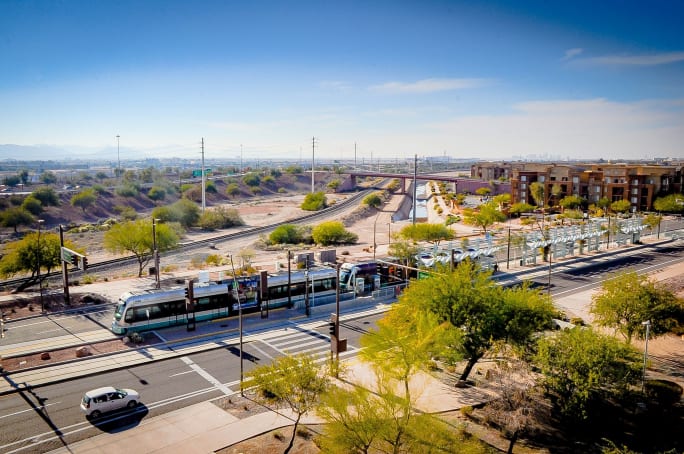
Valley Metro introduced its light rail system in 2008, and it has been a game-changer for the region.
“It has fundamentally altered how residents and visitors travel across the metropolitan area,” Mefford-Miller says. “Light rail has spurred more than $17 billion in public and private economic investment along the corridor, attracting large-scale events and contributing to the growth and vibrancy of the region.”
The agency currently has two light-rail extension projects underway.
The Northwest Extension Phase II extends the current light rail line by 1.6 miles to the redeveloping Metrocenter Mall area and is on track to begin service in early 2024. This extension includes Valley Metro’s first elevated station and rail-only bridge over a major freeway.
The South Central Extension/Downtown Hub project is also under construction. This project includes 5.5 miles of new light rail, as well as a new transit hub and mixed-use development in the heart of downtown Phoenix.
Ad Loading...
“The South Central Extension is now 70% complete, and the opening of this project in late 2024/early 2025 will shift our light-rail system from one line to two lines,” Mefford-Miller says.
In June 2023, the FTA awarded Valley Metro with a Low-No Emission grant to incorporate 40-foot battery-electric buses into the current fleet.
Photo: Valley Metro
Other Valley Metro Initiatives, Updates
Valley Metro’s balancing act also includes testing autonomous vehicle technology, a strategic plan, and introducing digital fares through its app.
In 2019, Valley Metro partnered with Waymo to pilot a six-month demonstration project to understand how autonomous vehicles can be used for the Valley Metro RideChoice program. The evaluation was conducted by Arizona State University and funded in part by the Federal Transit Administration's (FTA's) Mobility on Demand (MOD) Sandbox program.
According to the agency, RideChoice provides transportation to seniors and passengers with disabilities using taxis and rideshare providers.
Valley Metro is exploring further autonomous vehicle partnerships following the collaboration with Waymo.
Ad Loading...
“We are considering expanding autonomous vehicle partnerships with new technologies as part of our ongoing strategic agency vision,” says Mefford-Miller. “Our communities and transit partners should expect to see related requests for proposals this year.”
The agency is also nearing the completion of a strategic plan with guidance and direction from its two boards of directors and stakeholders across the Valley.
“The plan will propel this agency into providing greater focus on customer experience, talent investment, security prioritization, leveraging best practices based on data and technology, and greater stakeholder collaboration,” says Mefford-Miller.
Last but not least, Valley Metro introduced digital fares through its app earlier this year.
Riders can now plan their trips, track their rides, and buy mobile fares using the app.
Ad Loading...
“In 2024, riders will be able to use reloadable fare cards and scan or tap fare on new fare readers across the system,” Mefford-Miller shares. “Both options are an account-based system where riders can add funds, track transaction history, view account balances, and more. This new fare system will help attract new and occasional riders to transit.”
Valley Metro didn’t miss a beat in its leadership transition and its new efforts indicate the agency is continuing to grow despite the challenges presented by the industry-wide workforce shortage and COVID-19 pandemic.
Contract Four is the largest in the Second Avenue Subway Phase 2 project and includes construction of station infrastructure, tracks, and signals for the subway expansion, MTA officials said. Work on Contract Four will begin in 2027.
The new regional transit authority appointed its first board chair and interim executive director while extending reduced fares across CTA, Metra, and Pace for eligible riders.
Reliability-Centered Maintenance helps transit agencies move beyond routine checklists to focus limited resources on the assets and failures that have the greatest impact on safety, reliability, and service.
The 90-day demonstration will deploy coordinated security teams at five light rail stations while testing controlled access and gathering data to guide future investments.
Learn about delivering 1300 gates at 91 stations while managing fare evasion. Explore the large scale deployment, solution customization and real-world results that affect the region. Prepare for deployment in your region now.
Between packed transit stations and team motorcoaches, see how agencies and operators across North America tackled the transportation demands of the 2026 FIFA World Cup.
The stopgap keeps federal transportation programs moving, but missing advance funding could complicate the transit and rail projects agencies are planning next.