AI pilot study set to launch in Helsinki and Chicago
The aim is to better understand rider behavior, reduce illegal parking and pavement riding, and harvest granular data to assist planners and policymakers looking to identify infrastructure gaps.
Scott Shepard・Head of Policy & Government Affairs, Drover.Ai
Set to launch in late July 2023, the three-month micromobility pilot project is a collaboration between the City of Helsinki, Forum Virium Helsinki, Business Helsinki, VTT, Voi Technology, Vianova I/O, and Drover AI.
Photo: Pexels/ArtMerikotka
5 min to read
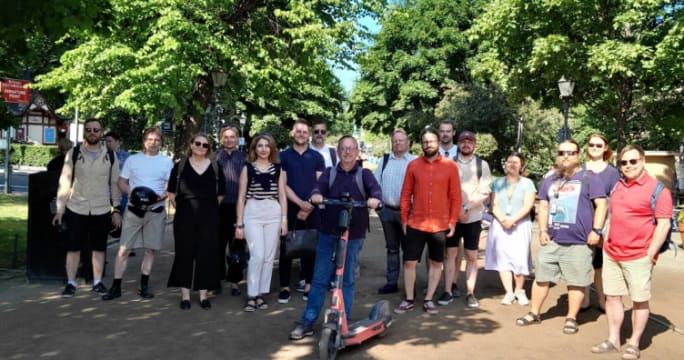
The author (center) with the team about to embark on two pilot studies.
Photo: Scott Shepard
This article originally published in Zag Daily
Drover AI is embarking on two parallel case study projects with the cities of Helsinki and Chicago to resolve multiple pain points that councils, operators, and users currently struggle with when integrating shared and dockless e-scooters in dense urban environments.
Ad Loading...
The aim is to better understand rider behavior, reduce illegal parking and pavement riding, and harvest granular data to assist planners and policymakers looking to identify infrastructure gaps.
A subset of e-scooters will be equipped with Drover’s patented Path Pilot AI & computer vision safety technology, and GDPR-compliant, edge-based telemetry data will also be collected during each project.
The Helsinki Project
Set to launch in late July 2023, the three-month pilot project is a collaboration between the City of Helsinki, Forum Virium Helsinki, Business Helsinki, VTT, Voi Technology, Vianova I/O, and Drover AI.
As a preview of the case study, a live demo of Drovers Path Pilot technology, in partnership with Voi technology and City of Helsinki was carried out on June 21. Stakeholders representing Finnish national parliament, Finnish department for transport, Helsinki city council, and other agencies were in attendance and able to test out the technology for themselves and better understand how AI & computer vision improves riding and parking outcomes.
The pilot is to be composed of two separate phases.
Ad Loading...
The first phase, lasting six weeks, is to harvest granular infrastructure data and visualize telemetry locations by time and infrastructure type in the Vianova platform.
The second phase will introduce a range of audio sounds (during business hours). These sounds will assist with rider behavior and feature unique sounds related to riding and parking events, such as sidewalks, bike lanes, and virtual parking stations. It is presumed the introduction of sounds will result in a shift in rider behavior across infrastructure type, and lead to other valuable data-driven insights (location of hot spots, potholes, and other potential conflict zones).
The case study will culminate in a technical white paper, to be co-authored by Drover and VTT. Geographic and statistical data over the course of the project will be further analyzed and presented in a snapshot of the Helsinki urban environment.
The white paper will also be published and presented to a number of mobility events, including POLIS Network, Smart City Expo World Congress, RISE Sweden, Open Mobility Foundation, and others.
The neighborhood-based case study will demonstrate how using a combination of AI & computer vision tech and analyzing real-time rider behavior can help identify complete streets investment opportunities in the Chicago Works Infrastructure Plan, thus aligning with transportation justice and mobility equity policies.
Photo: Pexels/ChaitGoli
Chicago’s Pilot Study
The neighborhood-based case study, in partnership with the City of Chicago DOT (CDOT), Shared Use Mobility Center (SUMC), SPIN, Blue Systems, and Drover AI, and building upon Chicago’s E-Scooter Program, will demonstrate how using a combination of AI & computer vision tech and analyzing real-time rider behavior can help identify complete streets investment opportunities in the Chicago Works Infrastructure Plan, thus aligning with transportation justice and mobility equity policies.
Ad Loading...
As planning and implementation of new infrastructure is typically a slow approval process, real-time behavioral analysis can provide more accurate insights into making iterative infrastructure improvements. And, by studying these infrastructure interventions at the neighborhood level, insights can be inferred and applied to the city level.
The results of the case study will be shared in a white paper to be prepared by SUMC and provide recommendations for real world solutions, such as:
Infrastructure/urban planning improvements.
Revising public policies and regulations.
Positioning both operators and regulators to take necessary and preventative operational actions.
The case study may eventually become more ambitious by incorporating added granularity on trip usage and infrastructure types. It is hoped that this technology can potentially be deployed in the Loop and other similar downtowns, where there are a variety of unique infrastructure types to be regulated and enforced, and which will further help to activate downtown streets.
Improved Safety & Infrastructure
Safety and management of public spaces are two of the most important pain points cities and regulators currently struggle with when considering inclusion of shared- and micro-modalities in the urban environment.
Ad Loading...
The insights gathered from these two case studies, and subsequent white papers, will help to inform decision makers, for example where a dense concentration of potential pedestrian and rider conflict zones are located. An added benefit of the case studies is the ability to gain more accurate knowledge about the quality of infrastructure and public spaces.
The granular infrastructure data is useful for:
Making changes to operational and fleet management regulations.
Creating a dialogue between all stakeholders to more accurately assess the dynamic across all modes in the built environment.
It is anticipated these insights will be just the start of more ambitious efforts on the part of stakeholders in both Helsinki and Chicago to take a data driven approach to improved public space management.
The End Goal
The Helsinki and Chicago case studies are a dual effort across two continents and two completely different markets to provide findings and recommendations into how regulators can use the best-in-class of commercial off-the-shelf safety technologies, such as Drovers Path Pilot, to promote more harmony in the management and investment of public spaces.
Ad Loading...
Granular infrastructure data is a game changer in the industry and is being sought out by all stakeholders to get a better understanding into how shared- and micro-modalities can align with sustainable public policies and help to deliver on the promotion of active transportation and modal shift (away from single car ownership).
We are eager to share the results of our findings this autumn and will continue to promote solutions that resolve the unique pain points that regulators are tasked to resolve on a daily basis.
With $610 million available through the FY 2026 Buses and Bus Facilities Competitive Program and the Low or No Emission Grant Program, agencies must build a compelling case before the September 21 deadline that balances environmental compliance with operational feasibility.
The global cycling conference highlighted how cities are integrating bicycles into multimodal transportation networks, expanding cycle tourism and reshaping urban mobility.
Mike Bismeyer — often known as “The Kindness Guy” — has spent more than 17 years in public transit and mobility, serving in industry leadership roles, speaking across North America, and advocating for stronger workplace cultures. But his message doesn’t come from theory. It comes from lived experience.
Transport leaders from around the world gathered in Leipzig, Germany, for the 2026 International Transport Forum to discuss resilience, climate impacts, supply chains and the future of sustainable mobility.
Polis comprises cities and regions, as well as corporate partners, from across Europe, promoting the development and implementation of sustainable mobility. This year’s event had over a thousand attendees across various policy forums and an exhibition.
Across North America and beyond, transit agency officials are contending with a perfect storm of operational headaches and strategic challenges that hamper daily service and long-term progress.
Simply incentivizing electrification is not enough to make a meaningful impact; we must shift our focus toward prioritizing public transportation and infrastructure.