As our world becomes more connected, transit agencies must contend with an ever-growing number of onboard technology applications.
Photo: Canva
4 min to read
As our world becomes more connected, transit agencies must contend with an ever-growing number of onboard technology applications.
From passenger counting, Wi-Fi, and video surveillance to telematics, a typical railcar may need to support as many as 10 individual internet-reliant functions.
Ad Loading...
Transit agencies often evaluate each of these applications in isolation, aiming to maximize each individual investment.
The problem with this approach is that multiple siloed applications add up to a major expense for agencies already grappling with financial constraints.
The math doesn’t add up. They are investing heavily in new technologies, but are having to manage multiple back-end systems and suppliers while receiving poor performance, which doesn’t equal the expenditure.
To fix it, agencies need to rethink their approach and move toward a holistic investment that consolidates technology platforms as much as possible to deliver more value for money and overall operational efficiency.
Passenger Wi-Fi is the first thing that comes to mind when we think of internet connectivity on public transport vehicles.
Photo: Canva
Sum of Piecemeal Technologies Equals Poor Performance
Passenger Wi-Fi is the first thing that comes to mind when we think of internet connectivity on public transport vehicles. But, Wi-Fi is the tip of the iceberg for modern trains and buses.
Ad Loading...
Many transit operators use separate systems for various functions: cellular connectivity for passenger Wi-Fi, an onboard router for digital video surveillance, and another router for infrastructure monitoring.
The result? Subpar performance. Cellular connectivity can be spotty, particularly for vehicles that pass through rural areas, and may struggle to handle the sudden load of hundreds of passengers joining the network at once. These unreliable connections not only affect passengers but also pose significant challenges to critical onboard digital systems.
A transit operator would never run a vehicle network without the ability to track, control, or maintain it.
However, agencies that rely on cellular connectivity — where each vehicle connects directly to the nearest available cell tower — lose control over data usage on their buses or trains. This setup creates a scenario where multiple devices compete for the same bandwidth, denying the operator the opportunity to intervene, improve efficiency, or balance data loads based on who or what is using the network.
Some countries, such as Germany and Sweden, are working on improving cellular coverage and capacity for both 4G and 5G networks along major train routes.
Ad Loading...
But developing high-capacity cellular networks that span entire long-distance routes is expensive and time-consuming — and doesn’t necessarily solve all the technical challenges.
Fortunately, there’s a cheaper, easy-to-install alternative for improving connectivity.
Consolidation Multiplies Value and Performance
The solution lies in consolidation.
Instead of using separate routers for Wi-Fi, fare collection, and computer-aided dispatch/automatic vehicle location (CAD/AVL) systems, transit agencies can adopt a single onboard connectivity platform. This approach not only cuts equipment costs but also simplifies operations.
Additionally, it can significantly boost overall connectivity performance.
Ad Loading...
By using onboard connectivity platforms, agencies consolidate the numerous devices vying for cell tower connections into a single data stream, enhancing connectivity for all users and systems.
Operators can prioritize traffic, ensuring critical applications receive the necessary bandwidth, while less important data is throttled as needed. This allows agencies to regain control over network usage, balancing passenger demands with the needs of staff and onboard systems.
As a result, they can deliver a superior passenger experience while guaranteeing essential services like staff communication, real-time video surveillance, and even signaling are prioritized.
Installing onboard connectivity platforms is faster and more cost-effective than building cellular networks, and these platforms will continue to benefit from advancements in cellular, wayside, and satellite technologies in the future.
Research from late 2022 identified the top priorities for rail passengers as value for money, reliability, and punctuality, accurate train time information, getting a seat, and personal security.
Ad Loading...
Meeting these demands requires data — from track infrastructure monitoring to real-time journey updates, occupancy stats, and video surveillance — all of which can be optimally supported by an onboard connectivity platform.
By using onboard connectivity platforms, agencies consolidate the numerous devices vying for cell tower connections into a single data stream, enhancing connectivity for all users and systems.
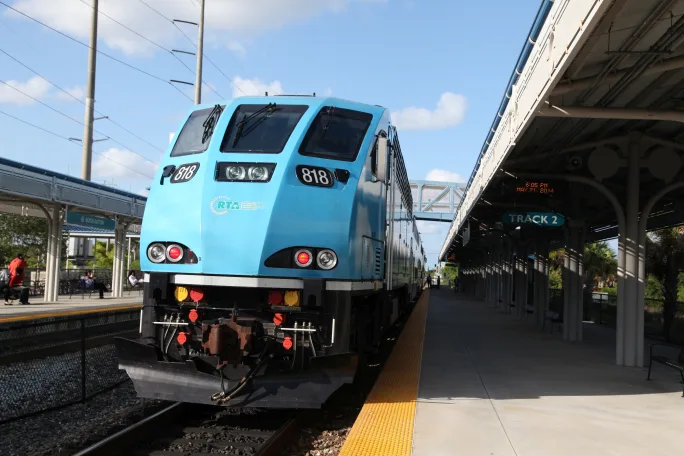
Photo: TriRail
Avoiding Unforced Errors to Stay Above the Line
Transit agencies are caught between the need to manage tight budgets and the pressure to improve service and boost ridership.
The fragmented approach to technology investments only adds strain, driving up costs while failing to deliver the expected return on investment. Ignoring this issue is no longer an option.
Public transit must unify its siloed systems into a single platform that also consolidates data streams, enhancing connectivity for everyone onboard.
The more a transit operator consolidates its investments, the greater the value and efficiency gained from each one.
With $610 million available through the FY 2026 Buses and Bus Facilities Competitive Program and the Low or No Emission Grant Program, agencies must build a compelling case before the September 21 deadline that balances environmental compliance with operational feasibility.
The global cycling conference highlighted how cities are integrating bicycles into multimodal transportation networks, expanding cycle tourism and reshaping urban mobility.
Mike Bismeyer — often known as “The Kindness Guy” — has spent more than 17 years in public transit and mobility, serving in industry leadership roles, speaking across North America, and advocating for stronger workplace cultures. But his message doesn’t come from theory. It comes from lived experience.
Transport leaders from around the world gathered in Leipzig, Germany, for the 2026 International Transport Forum to discuss resilience, climate impacts, supply chains and the future of sustainable mobility.
Polis comprises cities and regions, as well as corporate partners, from across Europe, promoting the development and implementation of sustainable mobility. This year’s event had over a thousand attendees across various policy forums and an exhibition.
Across North America and beyond, transit agency officials are contending with a perfect storm of operational headaches and strategic challenges that hamper daily service and long-term progress.
Simply incentivizing electrification is not enough to make a meaningful impact; we must shift our focus toward prioritizing public transportation and infrastructure.