



Innovation, maintenance's best honored at BusCon 2019
METRO Magazine honored seven bus operations and their supplier partners, as well as two of the nation's top maintenance directors.

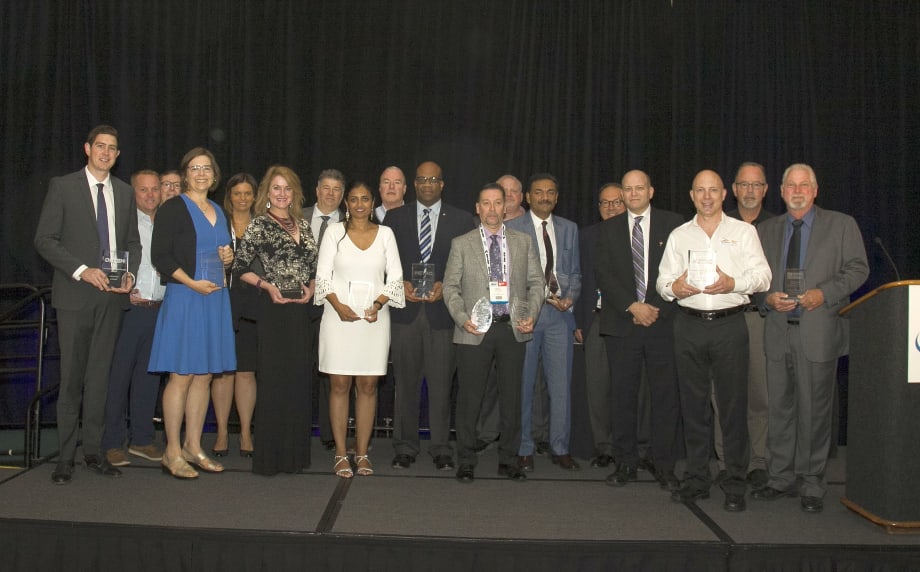
In all, METRO honored seven bus operations and their supplier partners for implementing a new initiative that helped them improve training, save money, run more efficiently, streamline operations, or improve safety.
Mark Hollenbeck
In all, METRO honored seven bus operations and their supplier partners for implementing a new initiative that helped them improve training, save money, run more efficiently, streamline operations, or improve safety.
Mark Hollenbeck
Innovators and maintenance directors were honored at BusCon on Wednesday during METRO Magazine's annual Innovative Solutions Awards, which took place in Indianapolis.
In all, METRO honored seven bus operations and their supplier partners for implementing a new initiative that helped them improve training, save money, run more efficiently, streamline operations, or improve safety.
Innovative Solutions Winners
This year’s winners include:
Romaine Electric and Keolis: The Litens Monster OAD pulley eliminates and captures typical horsepower losses, which enables operations to experience savings both in fuel and their carbon footprint. With just a simple 15-minute installation, Keolis in Las Vegas saved over $150 thousand in the first 12 months of using the product.
The Transit Authority of River City (TARC) and ZED Digital: TARC partnered with ZED Digital to launch a mobile app, which enables customers to seamlessly plan trips across multiple modes of travel. The next phase of the platform includes real-time parking availability and an added integrated payment solution, which will allow customers to pay for their full trip, across all platforms within the app.
Austin, Texas’ Capital Metropolitan Transportation Authority and Swiftly:Capital Metro awarded a contract to Swiftly Inc. in for the provision of General Transit Feed Specification for Real-Time data services. The partnership enabled Capital Metro the agility to update the feed with detour data daily instead of republishing a schedule through its planning software. After going live, the agency’s predication accuracy increased 30% for the three-minute arrival window and 15% for the three-to-six-minute timeframe.
The Los Angeles County Metropolitan Transportation Authority and Connixt Inc.: By digitizing and developing a mobile app for LA Metro’s inspections, maintenance and state-of-good-repair processes for rolling stock and facilities, Connixt have enabled the agency to ensure a safe mode of operation with real-time asset monitoring, while also providing safer and better maintained vehicles for all of its customers. In addition, it helps the agency better comply with federal and state mandates related to State of Good Repair and environmental regulations.
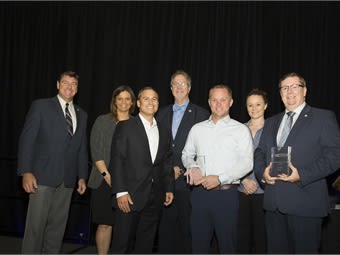
Proterra and the Rock Island County Metropolitan Mass Transit District officials flank METRO Magazine Publisher James Blue (third from left) during the awards ceremony at BusCon 2019.
Mark Hollenbeck
Proterra and the Rock Island County Metropolitan Mass Transit District: After adding five additional Proterra battery-electric buses and the necessary infrastructure to charge the vehicles, MetroLINK developed a ceiling-mount system, which allowed them to make the most of their limited space as well as optimize the bus charging process. The result reduced occurrences where units placed adjacent to drive lanes were damaged, as well as the manpower typically necessary to physically move the buses to be charged.
Gwinnett County Transit and TransLoc: Gwinnett partnered with TransLoc to offer residents in Snellville a microtransit solution to transport residents from their homes to medical appointments, shopping centers, places of employment and other local destinations. Upon launch, the service provided nearly 30,000 passenger trips in the first 8 months to residents that previously had no access to public transit services, resulting in a significant impact on the community as a whole.
The City of West Sacramento (Calif.), Lone Tree (Colo.) Link and Via Transportation Inc.: As a result of its MAP program, the City of West Sacramento teamed with Via to provide an on-demand program that featured flat-rate fares, wheelchair-accessible vehicles, and served unbanked individuals. The results of the program found that customers were utilizing the service more than driving or traditional TNCs, while also increasing safety for the rider. It also facilitated community building and environmental benefits through the usage of shared rides.
With two buses running a combined 150 hours per week, the new “Link” has carried over 7,000 passengers — almost 800 per week — compared to just 20,000 rides in 16 months under the previous service. In this time, weekly ride requests have increased 15%, while completed rides have increased by 41%. At the same time, sharing efficiency across the Link service has surged. Today, approximately 51% of all Lone Tree Link trips are shared, up from 38% at launch. Vehicle utilization has increased since launch from 4.7 to 6.2 rides per vehicle operating hour.
Maintenance Director of the Year
METRO also handed out its Transit Maintenance Director of the Year awards to two people who have gone above and beyond to create a well-run maintenance shop.
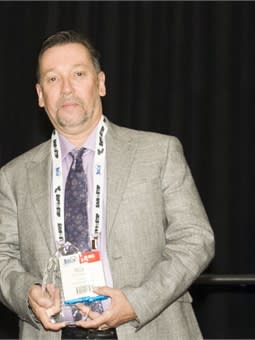
Rick Kazawitch of Volusia County Public Transit System (Votran).
Mark Hollenbeck
This year’s winner in the under-500-vehicle category is Rick Kazawitch of Volusia County Public Transit System (Votran). Kazawitch maintains a fleet that consists of 82 fixed-route buses, 76 paratransit buses, and 20 support vehicles at Votran, where he has worked for more than 38 years. While the agency has introduced more service and increased frequencies, Kazawitch and his team have kept pace with the additional wear-and-tear on their vehicles while also reducing the number of road calls year over year.
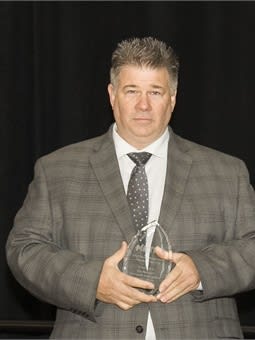
Ed Bennett of the Tri-County Metropolitan Transportation District of Oregon.
Mark Hollenbeck
In the over-501-vehicle category, this year’s winner is Ed Bennett of the Tri-County Metropolitan Transportation District of Oregon. Bennett oversees operations for TriMet’s three bus maintenance facilities, which keeps the agency’s fleet of more than 719 buses rolling every day. Among Bennett’s greatest accomplishments since taking over more than three years ago was to implement a PMI program, which has helped identify and fix issues in a more efficient manor, resulting in an increase in mean distance between failures to go from 4,000 to 14,600 miles.
The Propane Education & Research Council also honored operations for their utilization of propane autogas in their fleets. This year’s winners included Davidson County, N.C.; Votran; Island Explorer National Park; and Cook County Forest Preserves.
More Management

METRO Opens Submissions for 2026 Motorcoach Awards
Nominations are now being accepted for METRO Magazine’s Operator of the Year and Innovative Operator of the Year awards.
Read More →
New York MTA Advances Final Contract for Second Avenue Subway Expansion
Contract Four is the largest in the Second Avenue Subway Phase 2 project and includes construction of station infrastructure, tracks, and signals for the subway expansion, MTA officials said. Work on Contract Four will begin in 2027.
Read More →
Transit Agencies Highlight Safety Gains at National Summit
Leaders from 15 major transit systems shared crime-reduction results and safety initiatives while discussing the role of continued federal support.
Read More →

NITA Names New Leadership, Expands Reduced-Fare Program at First Board Meeting
The new regional transit authority appointed its first board chair and interim executive director while extending reduced fares across CTA, Metra, and Pace for eligible riders.
Read More →
Beyond the Checklist: A Structured Approach to Transit Maintenance
Reliability-Centered Maintenance helps transit agencies move beyond routine checklists to focus limited resources on the assets and failures that have the greatest impact on safety, reliability, and service.
Read More →
APTA 2026 Nominating Committee Selects Leadership Slate, Names Chair and Vice Chair Nominees
Leadership changes will help shape the association’s priorities and its representation of the transportation industry during the 2026–2027 term.
Read More →
DART Launches Major Security, Fare Enforcement Initiative
The 90-day demonstration will deploy coordinated security teams at five light rail stations while testing controlled access and gathering data to guide future investments.
Read More →
Advancing Fare Collection Through Technology and Innovation
Learn about delivering 1300 gates at 91 stations while managing fare evasion. Explore the large scale deployment, solution customization and real-world results that affect the region. Prepare for deployment in your region now.
Read More →
Game Day in Motion: Moving Millions During the 2026 World Cup
Between packed transit stations and team motorcoaches, see how agencies and operators across North America tackled the transportation demands of the 2026 FIFA World Cup.
Read More →
Surface Transportation Extension Averts Shutdown, Leaves Transit Funding Gap
The stopgap keeps federal transportation programs moving, but missing advance funding could complicate the transit and rail projects agencies are planning next.
Read More →