



Leveraging the Strength of Branding to Solve ‘R’ Challenges
How engaging staff and riders to overhaul the perception of an agency or line improves outcomes.

My Ride Rock Hill developed a brand characterized by hospitality, simplicity, and dependability.
City of Rock Hill
In today’s rapidly changing transportation market, there is an opportunity to reinvigorate a transit agency’s brand to strengthen vital relationships with its workforce and customers, and bolster its service in the community.
A community’s perception of a transit agency or service brand includes everything from the usability of the trip planning service to the actual operations, and for many, a daily greeting on a bus. A strong brand sets the framework for an agency’s ability to successfully deliver its mission holistically.
Understanding and articulating the brand purpose and using every opportunity to carry out its promise can enhance ongoing service and ridership recovery efforts.
At the core of every “brand” is its vision, or promise, as defined by its stakeholders. The brand promise is the value or experience that customers expect to receive every time they interact with an organization. For agencies facing employee retention and/or customer ridership challenges, a brand update can realign an organization’s promise to meet the expectations of its operators and riders today. It can also refresh and reinforce the experience the agency intends to deliver.
Branding to solve “R” Challenges: Retention and Ridership
Evaluating your agency’s brand promise can help you understand your staff and customers’ perceptions today and how to position your agency to create an engaged workforce and loyal customers tomorrow.
When done right, a successful brand refresh engages transit operators directly involved in delivering a positive brand experience. As the frontline brand ambassadors, it’s important to listen to their insights and incorporate their ideas. Give them a clear understanding of their value and their role and provide them with the tools and training needed to deliver your brand’s promise. When they see themselves in your brand and believe in its mission, your brand’s authenticity will come through to your customers and potential recruits.
Equally important in a brand development process is engaging riders and creating external champions for the transit system. A brand that reflects riders’ values makes people feel a part of the system. It rebuilds their trust and helps them identify with the brand.
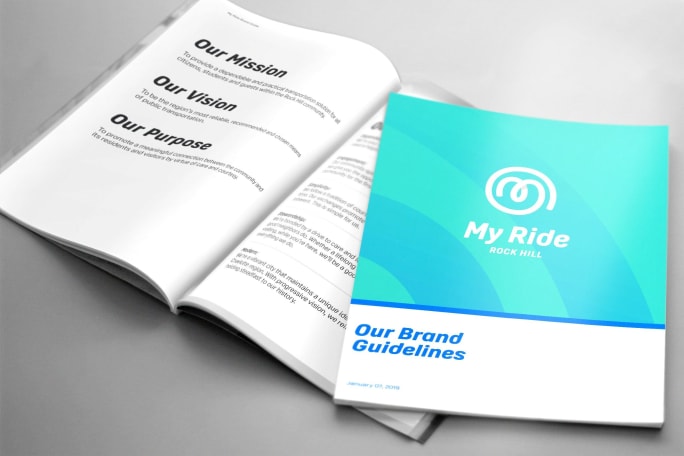
The My Ride Rock Hill continues to work on building strong connections with its riders andoperators, leading to loyalty and long-lasting positive impressions.
HDR
Branding for the Future
In 2019, the City of Rock Hill, S.C., debuted the first all-electric bus fleet in the country — a “free-to-ride” service. This new service line deserved a brand that reflected its place in the community and its values as a reliable transportation provider. Pre-pandemic, the agency was on track to hit twice the number of expected riders.
Through an intensive workshop process, the city decided its brand would be simple, modern, and playful. This was reflected in a bright color scheme and a friendly, jovial voice in all communications. The brand purpose is “To promote a meaningful connection between the community and its residents and visitors by virtue of care and courtesy.”
The city introduced its operators to the community at a public event, asking the drivers to run through a paper banner as a sports announcer shared their names. The bus line’s success relies on the operators, says Rock Hill Communications and Marketing Manager Katie Quinn. And, the city wanted the operators and the community to know it.
“The community embraced this process,” says Quinn. “Partly because the branding was an engaging process and partly because the idea for the bus system came from feedback from the community.”
My Ride Rock Hill continues to work on building strong connections with its riders and operators, leading to loyalty and long-lasting positive impressions.
Outreach Workshops are the Key to a Successful Brand
The process of creating a brand is intensive and collaborative. The key is to facilitate a series of workshops with a variety of internal and external stakeholders. These workshops are designed to gather the community’s values, the agency’s mission and purpose, and the current perceptions of the agency or service line. This will form the basis of all the pieces of the brand, whether it is more traditional or modern-looking, whether the colors are bright or subdued, and so on.
Brand development starts with asking big-picture questions of staff, operators, and customers. These decision points or milestones are rooted in determining if services are safe and reliable; if digital tools are intuitive and accessible; and/or if signage is consistent, helpful, and ADA compliant. It’s also imperative to hear from the stakeholders about the touchpoints and whether they feel modern and fresh; from the shelters and stops to the maps and wayfinding — are the relationships between all service offerings understood and are they clearly communicated?
Most importantly, is the agency’s position within the communities it serves clearly articulated? Its mission, vision, purpose, and values are not just defined but articulated in a way that engages employees and riders. In other words, can a brand foundation rally the team and community behind the organization?

Through the branding process, Fredericksburg gained a new, fresh look for the agency that complements the new City of Fredericksburg identity and brings clarity to the services provided.
HDR
Successful Buy-In from Operators in Fredericksburg
Fredericksburg Regional Transit in Virginia went through a rebranding process in 2021, giving the agency’s name, mission, and values, as well as its buses and other visual touchpoints, a refresh from when the agency was founded in 1996.
The rebranding gave the agency a chance to better align with the City of Fredericksburg brand, to better reflect the personality of the city by honoring its heritage and focusing on the future, and to bring more clarity to the services they provide.
An important step in the process involved a workshop with operators, designed to engage them, learn how they use the brand, and discuss how to make the brand work for them. One of the takeaways was that the prior uniforms were a point of concern — everything from comfort of material to types of pockets and colors. That led to a uniform redesign to make the employee experience better. Now those operators have buy-in as they serve as the face of the brand, passing that brand experience through to the customer.
In the end, Fredericksburg gained a new, fresh look for the agency that complements the new City of Fredericksburg identity and brings clarity to the services provided. Buses that were previously routinely mistaken for tourist buses are being adorned with the new logo and visual motif.

The wave shape also flows through the station architecture, bringing consistency to all touchpoints of the brand.
HDR
A New Rapid Transit Line: Branding LCRT
Lowcountry Rapid Transit is South Carolina’s first rapid transit system and was just advanced into engineering as part of the Federal Transit Administration’s (FTA) Capital Investment Grants New Starts Program. The system is being designed to connect people to each other and to places that will help them continue to thrive.
During the brand development process which began in 2019, the Berkeley-Dorchester-Charleston Council of Governments recognized that this rapid system should stand apart from the local bus service lines and that the process should focus on the future riders at its core.
In visioning workshops with the local community, values of nature, culture, and lifestyle were identified and were ultimately reflected in every aspect of the brand. From the curvature of the station architecture to the wave that flows through the identity, each touchpoint is intentional and reflective of what was heard in the community workshops.
“We recognized immediately that the work we were doing would play a significant role in both the perception and ridership success of Lowcountry Rapid Transit,” says Ron Mitchum, executive director of the Berkeley-Charleston-Dorchester-Council of Governments. “By bringing the public and stakeholders into the branding process early, we’ve formed meaningful relationships that have created project champions and empowered them to have an ownership stake in the system’s development. We believe Lowcountry Rapid Transit has a solid footing for future success with a ridership base that was engaged long before the system was constructed.”
Following Branding Best Practices
The American Public Transportation Association also touts the benefits of branding in a standards development program recommended practices document, “BRT Branding, Marketing, and Imaging.”
“A consistent and compelling brand creates pride and a sense of contribution for employees,” it says.
In the document developed by its Bus Rapid Transit working group, APTA goes on to say that studies suggest that branding and imaging can contribute to 10% to 20% increases in ridership. Other benefits include improved employee satisfaction and retention, increased customer loyalty, and enhanced outreach efforts. It also says the FTA will consider branding when determining eligibility for the Capital Investment Grants program.
Branding Sets an Agency up for Success
A brand is, at its heart, how people connect with and feel about an organization. It encompasses all the ways a customer interacts with the transit system, from the digital tools of planning a trip to a bus driver’s greeting. Transit has a special place in communities, and in people’s hearts — a new brand, or a refresh, can bring out the best of that relationship between a transit system and its riders and staff.
Transit has the power to create more connected, equitable, and sustainable communities. And a meaningful brand can help agencies get there.
About the Author: Theresa McClure, Samantha Dubay, and Drew Watts are leaders in HDR's Strategic Communications practice
More Management

METRO Opens Submissions for 2026 Motorcoach Awards
Nominations are now being accepted for METRO Magazine’s Operator of the Year and Innovative Operator of the Year awards.
Read More →
New York MTA Advances Final Contract for Second Avenue Subway Expansion
Contract Four is the largest in the Second Avenue Subway Phase 2 project and includes construction of station infrastructure, tracks, and signals for the subway expansion, MTA officials said. Work on Contract Four will begin in 2027.
Read More →
Transit Agencies Highlight Safety Gains at National Summit
Leaders from 15 major transit systems shared crime-reduction results and safety initiatives while discussing the role of continued federal support.
Read More →

NITA Names New Leadership, Expands Reduced-Fare Program at First Board Meeting
The new regional transit authority appointed its first board chair and interim executive director while extending reduced fares across CTA, Metra, and Pace for eligible riders.
Read More →
Beyond the Checklist: A Structured Approach to Transit Maintenance
Reliability-Centered Maintenance helps transit agencies move beyond routine checklists to focus limited resources on the assets and failures that have the greatest impact on safety, reliability, and service.
Read More →
APTA 2026 Nominating Committee Selects Leadership Slate, Names Chair and Vice Chair Nominees
Leadership changes will help shape the association’s priorities and its representation of the transportation industry during the 2026–2027 term.
Read More →
DART Launches Major Security, Fare Enforcement Initiative
The 90-day demonstration will deploy coordinated security teams at five light rail stations while testing controlled access and gathering data to guide future investments.
Read More →
Advancing Fare Collection Through Technology and Innovation
Learn about delivering 1300 gates at 91 stations while managing fare evasion. Explore the large scale deployment, solution customization and real-world results that affect the region. Prepare for deployment in your region now.
Read More →
Game Day in Motion: Moving Millions During the 2026 World Cup
Between packed transit stations and team motorcoaches, see how agencies and operators across North America tackled the transportation demands of the 2026 FIFA World Cup.
Read More →
Surface Transportation Extension Averts Shutdown, Leaves Transit Funding Gap
The stopgap keeps federal transportation programs moving, but missing advance funding could complicate the transit and rail projects agencies are planning next.
Read More →