The Future of Transit Workforce: Managing Post-Pandemic Shifts
Agencies are working to implement new and more time-efficient ways to boost the job market, all while maintaining adequate service levels, a balanced budget, and additional funding avenues.
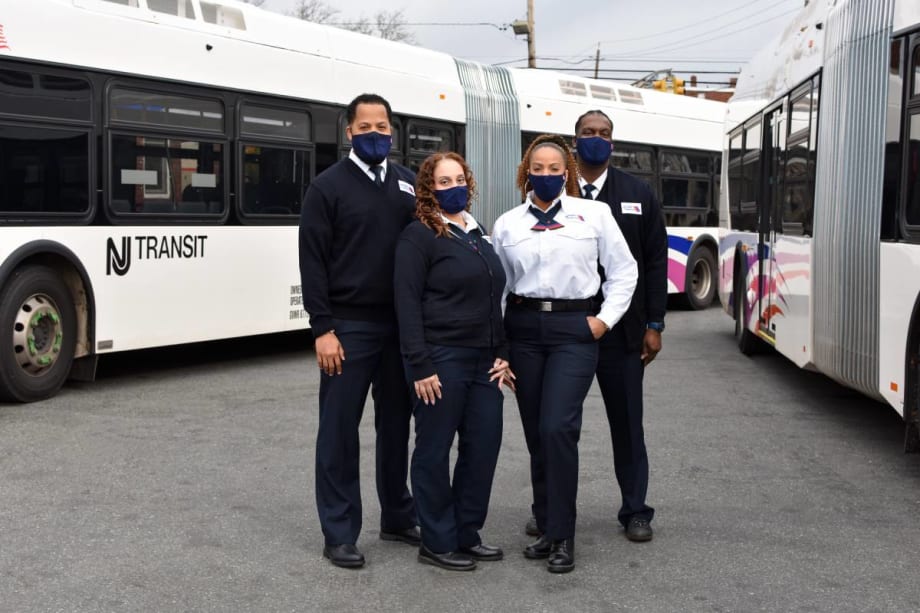
NJTRANSIT has adopted several new hiring initiatives since the start of the COVID-19 pandemic, including signing bonuses and on-site CDL testing, to recruit more bus operators.
Photo: NJTRANSIT
7 min to read
As ridership declined for many transit agencies during the height of the COVID-19 pandemic, so did the stability of the industry’s workforce.
According to a policy brief released by the American Public Transportation Association (APTA) in January 2021, nearly two-thirds of transit agencies (65%) were forced to cut service in 2020. And, as a result, more than 20% of those agencies had to conduct layoffs, while 17% had furloughs.
Ad Loading...
While most transit agencies, thankfully, were able to avoid layoffs during this time, they are now hard-pressed to implement more cost- and time-efficient ways to boost the industry’s workforce, all while maintaining adequate service levels, a balanced budget, and additional funding avenues.
A Strained Workforce
The pandemic has impacted the transit workforce in more ways than one: Layoffs, retirements, people working from home, and/or seeking unemployment benefits. Pam Boswell, APTA’s VP, workforce development and educational services, says each of these factors have contributed to the recent uptick in hiring.
“Some [workers] who were approaching retirement age may have decided to leave the industry during COVID, [while] some may have taken advantage of package options,” she explains. “Based on member feedback, it appears the larger transit agencies and organizations have had the highest rate of staff departures. For example, while mid-size and smaller transit agencies have implemented reassignment strategies to maintain their operational staff, in some instances, larger agencies are seeking hundreds of operators.”
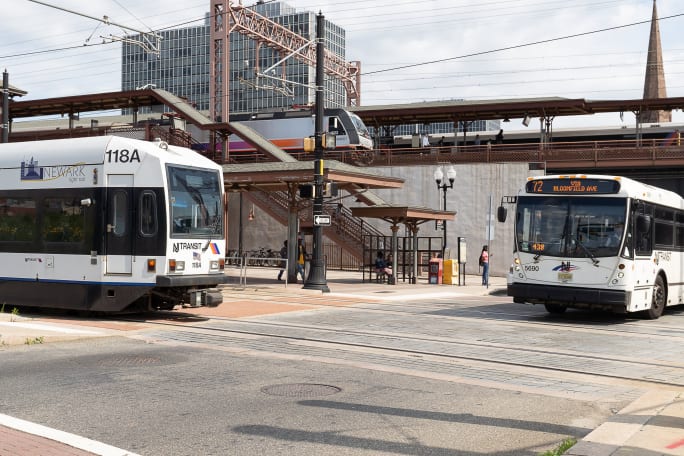
NJTRANSIT, which has close to 11,000 employees, has seen a substantive increase in retirements and voluntary attrition that has resulted in the need to hire more people, particularly in bus operations.
Photo: NJTRANSIT
Take NJTRANSIT, for example. The agency, which has close to 11,000 employees, has seen a substantive increase in retirements and voluntary attrition that has resulted in the need to hire more people, particularly in bus operations.
“In the last three months, alone, this need for new bus operators has led to several initiatives, including a $6,000 signing bonus and on-site CDL testing to name a few,” says Mariluz Garcia-Diaz, NJTRANSIT’s sr. public information officer.
Ad Loading...
Although vaccinations are likely to help ease the fears workers may have in being on the frontlines, many are still searching for jobs where they are less likely to be exposed to COVID-19 — or any other deadly virus down the road, according to Carrie Black, IndyGo’s director, communications.
Consequently, interest in remote working arrangements have increased.
“There have been far more questions related to remote working arrangements, but that has not dampened interest in IndyGo’s administrative and executive positions,” Black says. “The coronavirus outbreak has had a dramatic psychological effect on workers, and people are reassessing what they want to do and how they want to work, whether in an office, at home, or some hybrid combination.”
Collectively, IndyGo currently has 21 vacant positions that it is actively recruiting for and has posted on its employment webpage. Most of the positions call for people who can’t work from home, such as bus operators, mechanics, and general laborers.
To meet anticipated service increases and address attrition, Black says IndyGo is looking to hire roughly 10 to 15 bus operators each month to ensure they are back at their pre-pandemic staffing levels, with over 500 operators.
Ad Loading...
Identifying, Attracting A New Transit Workforce
Like NJTRANSIT’s implementation of an increased signing bonus, a growing number of employers are raising wages and improving benefits to attract and retain workers, which has made the competition for service workers, particularly those who hold CDLs, even stronger.
In May, the Metropolitan Atlanta Rapid Transit Authority (MARTA) announced that it would be providing a one-time $3,500 COVID-19 pandemic payment to approximately three-fourths of its frontline and represented employees, including bus and rail operators, mechanics, and supervisors, as well as select members of the MARTA Police Department.
In addition to the one-time payment, MARTA’s 2,811 employees represented by the Amalgamated Transit Union (ATU) Local 732 are also expected to receive a 2% general wage increase in February 2022.
“This program has been very well received,” says Luz Borrero, MARTA’s chief administrative officer. “We’ve done quite a bit of work to support our workforce and recognize their commitment and contributions through these trying times.”
As for recruiting new talent, IndyGo’s Black says COVID-19 has made the agency’s recruitment efforts more difficult due to the lack of in-person interaction.
Ad Loading...
Prior to the pandemic, IndyGo’s human resources department implemented several recruitment measures, including on-the-spot hiring and hiring blitzes to boost its workforce.
Now, with limited in-person options, the agency has reset its recruiting strategy by focusing on ways to improve the current work environment and is conducting exit interviews with staff members who are leaving the agency.
IndyGo has also expanded its hiring pool by adopting a Second Chance hiring initiative, which is intended to promote re-entry into the workforce and increase the pool of qualified applicants from which the agency can hire.
Under the new policy, implemented in May 2021, IndyGo will not make inquiries into an applicant’s criminal background until a conditional offer of employment has been made. If an applicant’s criminal background includes a conviction within the last seven years, the agency will conduct an individualized assessment of the situation.
“So far, we have not seen a significant increase in applicants [with the Second Chance hiring initiative],” Black says. “However, since the program’s inception, three of the four individuals who have applied and gone through the Second Chance Hiring assessment were hired, and we’ll continue to promote this initiative in our recruitment campaign.”
Ad Loading...
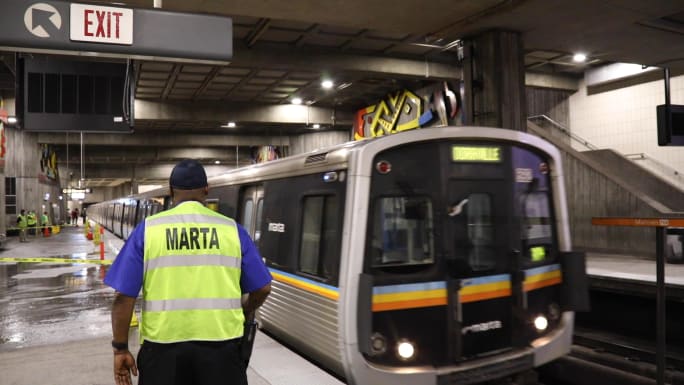
In May, MARTA announced that it would be providing a one-time $3,500 COVID-19 pandemic payment to approximately three-fourths of its frontline and represented employees
Photo: MARTA
Recruiting Through Partnerships
Strengthening local community outreach and recruitment capacity can also help aid transit agencies in their commitment to hiring more underserved or underrepresented individuals.
NJTRANSIT’s recent partnership with Edge4Vets, an organization that teaches former military personnel how to translate their military strengths into tools for success, is designed to help the agency meet its need for talent, as reflected in its 2030 Strategic Plan.
As part of the program, Edge4Vets and NJTRANSIT will offer a workshop series to prepare and connect New Jersey military veterans and transitioning service personnel to jobs that can lead to careers. It will also designed to connect eligible veterans to human resources recruiters at the agency to explore how to match their skills acquired in the military to future job opportunities.
“It is NJTRANSIT’s goal that the Edge4Vets pilot program will expand upon its success with military veterans to help NJTRANSIT meet other talent needs for women and minorities, and may potentially grow beyond the current pilot phase.”
Meanwhile, MARTA is focusing on its collaborations with local community organizations like WorkSource Fulton, Goodwill of North Georgia, the Atlanta North Georgia Labor Council, and the Urban League of Greater Atlanta, to host both virtual and in-person job fairs.
Ad Loading...
Hoping to enlist more bilingual personnel for the agency’s customer service sector, MARTA is also hosting hybrid job fairs with the Latin American Association, a nonprofit dedicated to helping Latinx individuals assimilate and become contributing members of Georgia’s community.
“We are a very diverse organization, and we are always very mindful of how important it is for us to reach out to our diverse community, not just from a standpoint of race, but also from varying socio-economic backgrounds,” Borrero says.
These kinds of efforts, she adds, can help employees re-establish a sense of purpose and ownership in the transit industry, thus reinforcing the industry's widespread mission to provide public transit to those who need it most.
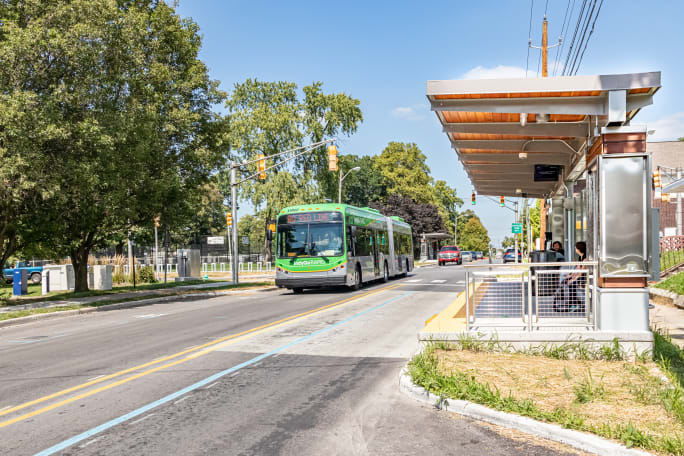
Most of the positions call for people who can’t work from home, such as bus operators, mechanics, and general laborers.
Photo:IndyGo
Looking Ahead Post-Pandemic
As transit agencies continue to adopt more programs and practices to address the industry's growing number of job openings, they are also rethinking their service planning, routes, and related services.
“How can they best adapt to a ‘new normal,’ or future? How can they be more responsive and flexible in meeting rider needs? These important decisions will impact the numbers, skills, and training needed in public and business transit organizations,” APTA’s Boswell says.
Ad Loading...
Additionally, with the introduction and use of new technologies, such as electric buses and other alternative fuel options, she says agencies may be finding themselves in situations where they, by virtue, are having to rethink how they do business, while also rethinking the jobs and skill requirements necessary to explore a future beyond the pandemic.
To help agencies better adapt to this transitional period, APTA has offered several resources — from robust webinars and town halls about the impact of the pandemic on public transit, including its workforce, to creating opportunities to produce toolkits and share lessons learned and/or best practices.
“We introduced APTAU Learning as a vehicle to promote our webinar series, specialized programming, online learning courses, and much more,” Boswell says. “For the first time, we offered a virtual, two-part training on electric buses for members.”
By offering more virtual resources, the association has been able to bring more voices to the table, engage new ideas, and deliver more ways to accelerate the onboarding and development of the industry’s workforce.
Contract Four is the largest in the Second Avenue Subway Phase 2 project and includes construction of station infrastructure, tracks, and signals for the subway expansion, MTA officials said. Work on Contract Four will begin in 2027.
The new regional transit authority appointed its first board chair and interim executive director while extending reduced fares across CTA, Metra, and Pace for eligible riders.
Reliability-Centered Maintenance helps transit agencies move beyond routine checklists to focus limited resources on the assets and failures that have the greatest impact on safety, reliability, and service.
The 90-day demonstration will deploy coordinated security teams at five light rail stations while testing controlled access and gathering data to guide future investments.
Learn about delivering 1300 gates at 91 stations while managing fare evasion. Explore the large scale deployment, solution customization and real-world results that affect the region. Prepare for deployment in your region now.
Between packed transit stations and team motorcoaches, see how agencies and operators across North America tackled the transportation demands of the 2026 FIFA World Cup.
The stopgap keeps federal transportation programs moving, but missing advance funding could complicate the transit and rail projects agencies are planning next.