Deriving the Bus: Building Today’s Facility for Tomorrow’s Buses
It’s easy to buy a bus, but the infrastructure necessary to operate, maintain, and store a fleet of them isn’t necessarily so easy, particularly if you’re switching from diesel to electric. It’s costly. And it can take a long time to put in place.
by Arthur Schurr
September 2, 2022
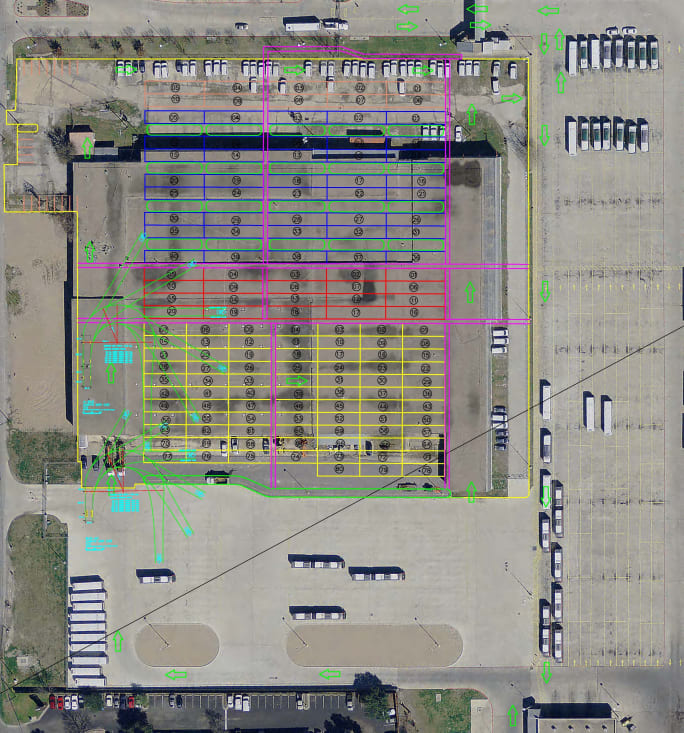
A 110,000-square foot bus transit operations center with capacity for
220 buses on an 18-acre site, the NOMF took less than 20 months from conception to completion.
Photo: Huitt-Zollars/CapMetro
9 min to read
Existential Public Transportation Challenge Number 483: Spend millions of dollars to plan and construct your agency’s new electric bus charging facility, addressing all current and future operational needs while accommodating a cutting-edge, dynamic technology. How hard could that be?
Capital Metro (CapMetro) Director, Vehicle Maintenance, Andrew Murphy; CapMetro Project Manager Katherine Gonzalez; and Huitt-Zollars VP Ken Hughes know that answer. They met that challenge in the form of CapMetro’s North Operations and Maintenance Facility (NOMF).
Ad Loading...
It sounded simple enough. Demolish an old mattress factory and convert the land into a state-of-the-art electric bus charging, maintenance, and storage facility for a burgeoning fleet of electric buses.
A significant design and engineering task, it also wasn’t rocket science, right? Think again. As with many things, the devil is in the details. And the details offer some vital lessons for transit agencies looking to create or expand their electric bus fleets. The CapMetro team likes to think of these as lessons earned. And earned them they have.
Part of CapMetro’s Project Connect — a $7.1 billion regional high-capacity, transit-expansion program — the NOMF is deceptively complex.
A 110,000-square foot bus transit operations center with capacity for 220 buses on an 18-acre site, the NOMF took less than 20 months from conception to completion, including the old factory demolition, site planning, design, final design, and construction. It was even on schedule and on budget. And the facility opened in December 2020, because it pretty much had to.
At a 2019 Earth Day press conference, then-CEO Randy Clarke declared CapMetro would “never buy another diesel bus again.”
Ad Loading...
Clarke also set a deadline of 2035 for CapMetro to have an all-zero emissions bus fleet. But CapMetro’s electric bus venture actually started in 2016.
At that time, electric bus ranges topped out at about 75 miles per charge. Knowing that couldn’t serve many CapMetro routes — some of which exceed 300 miles — Murphy also knew technology would improve. Fast forward to 2018. Murphy invited major electric bus manufacturers to supply models for in-route, on-street testing. Three did: BYD, New Flyer, and Proterra.
“We charged them at night and ran them all day on the routes, collecting real-life data, not theoretical grad-student data” adds Murphy. “We discovered they could each go about 150 miles on a charge and that gave us coverage on 40% of our routes. We knew we could start using them in service.”
But there was a catch. Where do you charge, store, and maintain an expanding fleet of new electric buses? Enter Gonzalez and the old mattress factory project.
“It’s easy to buy a bus, but the infrastructure necessary to operate, maintain, and store a fleet of them isn’t necessarily so easy,” Gonzalez explains. “Particularly, if you’re switching from diesel to electric. It’s costly. And it can take a long time to put in place.”
Ad Loading...
The NOMF team knew what they needed. But they also knew that constantly evolving electric bus and battery technology could complicate things tremendously.
Murphy points out, “We would have to design a facility to handle current needs as well as technology we won’t acquire for years. Plus we had to create a whole new maintenance program. We needed a design that could incorporate each yearly purchase as well as updated maintenance and storage. That was the challenge we put to Ken and Huitt-Zollars.”
“Fortunately, they had complete support at CapMetro,” explains Hughes. “We explored a number of options, including an overhead gantry-type system. But we recommended underground conduit and CapMetro agreed. That was a gutsy move on their part, as it was a greater upfront expense, but they saw the value in terms of future flexibility.”
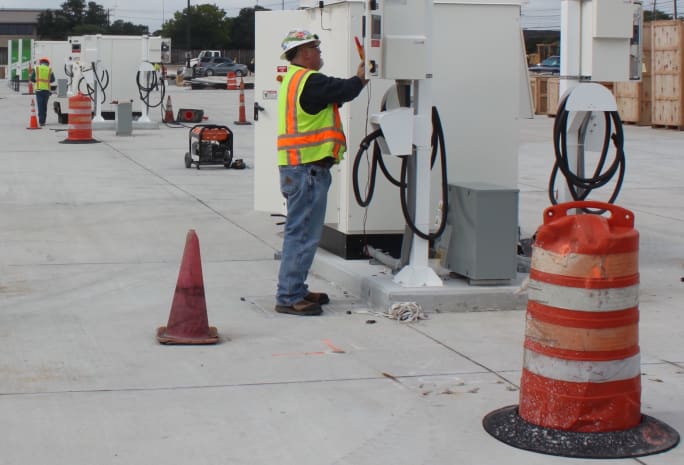
The NOMF plan centered on eight 1,500 KVA transformer arrays providing power for 16 rows of buses. Each row charges between eight (60-foot buses) and 11 (40-foot buses) vehicles, as well as left or right-side entry/charging and independent access. Initially only one array was connected.
Additional arrays were brought online as capacity grew. Fixed stub-ups with varying length charging cables connect to the underground conduit, granting flexibility. Finally, yard restriping and movable, sand-filled bumpers help bolster flexibility, capacity, safety, and protection.
Ad Loading...
The design Hughes, Gonzalez, and Murphy devised works because it covered every known challenge, while preparing for unknown challenges as best they could. What follows are fundamental elements, critical components of their process they hope will serve as a primer for anyone considering a similar implementation.
It sounded simple enough. Demolish an old mattress factory and convert the land into a state-of-the-art electric bus charging, maintenance, and storage facility for a burgeoning fleet of electric buses.
Photo: Huitt-Zollars/CapMetro
Don’t Shock Your Energy Supplier
Without energy, a bus charging facility is a parking lot. Getting sufficient, reliable energy to an electric bus charging site is paramount. But a bus charging facility is not like your home toaster, Murphy explains.
“We partnered with Austin Energy early on to make sure they were willing and capable of providing the energy load we needed," he says. "I had done some back-of-the-envelope calculations and suggested we’d ultimately need between 12 to 16 megawatts in our yard. They laughed and said that sounded like a high number. When they saw the actual tech specs, they stopped laughing.”
Gonzalez adds, “Each of our eight arrays is roughly equivalent to what’s needed to power a Walmart. Bringing that much power into one location is considerable. If you just show up at your energy provider with a cable that requires 10 megawatts and ask them to plug it in, they might not be able to supply the power you need. But if you give them five or six years advance notice — explain to them you don’t need all the power upfront — they can grow toward your needs through their expansion and capital improvement budget. If you don’t do that and they need to add power at your expense, it can cost upwards of a million dollars a mile.”
Set up meetings with your energy provider as early as possible, then meet regularly. The NOMF team met with Austin Energy monthly. But energy suppliers are not the only ones who should sit at the table as early as possible.
Ad Loading...
Existential Public Transportation Challenge Number 483: Plan and construct a new electric bus charging facility, addressing all current and future needs while integrating cutting-edge, dynamic technology.
Photo: Huitt-Zollars/CapMetro
Seconding Your First Responders
Things happen. But when they happen in a facility loaded with 12 to 16 megawatts, the response challenge can be much more difficult and dangerous. Don’t wait until something happens. Partner with area first responders to protect both them and you.
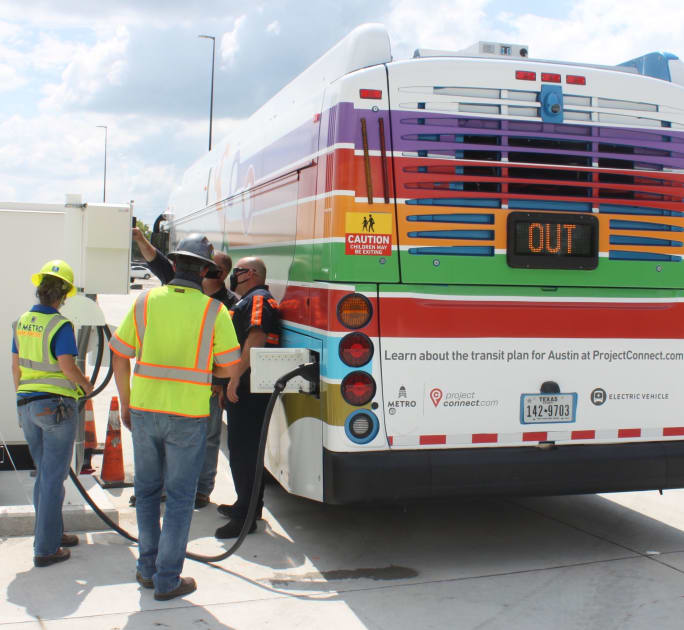
“We work really closely with the Austin Fire Department (AFD),” adds Gonzalez. “We gamed different scenarios with tabletop exercises and field exercises. For example, how do you handle a runaway battery fire? You can’t put water on it. How do we get everyone out of the yard safely? We never want AFD surprised by what we’ve got here, so we showed them upfront and keep them well informed, along with the Austin Police Department, EMS, tow trucks in the area, etc.”
Murphy adds, “These chargers are not designed to be turned on and off. And you never cut power without doing a controlled shut down. During one of the drills, a technician went to ‘turn off,’ an array and got enshrouded in smoke. If that were a real event, he could have died. We learned that we had to make sure we had alternate shut-off mechanisms. Integrating first responders and running through potential scenarios are incredibly important.”
Hughes points out that when conceptualizing the project, “Make sure you have a pretty big table. Representatives from planning, finance, operations, maintenance, real estate, IT, security, and first responders should all be there, along with your local energy supplier. And those are just the departments that were important for NOMF. If you have any special or different circumstances, you’d better get an even bigger table.”
At a 2019 Earth Day press conference, then-CEO Randy Clark declared CapMetro would “never buy another diesel bus again.”
Photo: Huitt-Zollars/CapMetro
Going Yard
Again, everyone thinks it’s simple. Design a bus yard. The team begs everyone to think again.
Ad Loading...
“Understand exactly how the yard will be used. That doesn’t sound hard, but it’s actually fairly complex when you really examine the operational aspects,” explains Hughes. “For example, where will the maintenance facility go? Where will the drivers layover? Change? Eat? How will they get from the buses to the facility safely? Informed design through operational input makes for a better facility.”
Gonzalez supports the point. “Initially we had crosswalks, but we found that drivers would walk between two buses and then into traffic to get to the crosswalk. And that was even after input from operations. So, it’s also important to remember that this is an iterative process and that designs may have to change several times. All the more reason why operations participation is vital," she says. "There are a lot of other practical questions, many that only operations people can pose and answer effectively. From sand-filled bumpers to protect one-piece composite buses to bus washing protocols, know exactly how the yard will be used and who will be using it.”
Reinventing the Steering Wheel
Whatever yard configuration you are contemplating, it has probably been done. Find out. Talk to others who have been where you’re going. Learn from their wisdom, mistakes, and expertise. The time spent doing this will prove to be a valuable investment.
Gonzalez relates CapMetro’s experience, “We engaged Huitt-Zollars. We did peer interviews with LA Metro, MARTA, Minneapolis Metro, IndyGo, and some Canadian transit agencies. We contacted eight different peer organizations. We did a lot of research. And it paid great dividends.”
Murphy illustrates her point, “For example, initially many people first put chargers along the perimeters of their yards, because it was easy to get electricity there. But as technology progressed, it became clear that was not the best design and many ended up ripping out millions of dollars of infrastructure that was less than five years old and redesigning their yards. We wouldn’t have known that had we not spoken to them.”
Ad Loading...
Interview everyone. Visit them and their facilities if you can. Talk to everyone who will talk to you. And make yourself available for anyone who calls.
Open Mind Over Matters
Keep an open mind. Answers do come from anywhere. And all ideas should be entertained and evaluated before being accepted, changed, or dismissed. Hughes credits CapMetro for doing exactly that, but explains that that, too, was a process.
“When we began, we were constrained by previous conceptions of the facility,” he says. “But we took an eraser to the plans and determined that we could take the existing paving and the new planned paving and reconceive and restripe the layout, for example. We increased parking 20%, which is not small. So, anyone thinking about doing this kind of project should really keep an open mind about what they have, what they want, and how to get it.”
Both Gonzalez and Murphy also credit Hughes and his team for fostering openness and transparency about the process and how best it could work.
“They were really great during these big meetings with all the stakeholders," says Hughes. "They listened to all the input and rolled with every change we wanted to make. We had a steep learning curve, and they were with us at every step. And that speaks to a really important point. Make sure to vet whoever you partner with and that they will keep an open mind to deliver exactly what you need.”
Ad Loading...
Existential Public Transportation Challenge Number 483: Plan and construct a new electric bus charging facility, addressing all current and future needs while integrating cutting-edge, dynamic technology. With the NOMF, it looks like CapMetro and Huitt-Zollars have put Existential Public Transportation Challenge Number 483 to rest.
About the Author: Arthur Schurr is a New York-based freelance writer who reports on transportation infrastructure.
The agency is seeking manufacturers for 650 new CNG buses to replace aging vehicles, improve reliability, and advance its broader fleet modernization strategy.
John Hroncich discusses BAE Systems’ modular and scalable approach, lessons learned from decades of real-world operations, and how agencies can identify electrification strategies that fit their fleets.
LA Metro’s Obed Mejia discusses technician training, evolving maintenance technology, fleet replacement, and strategies for getting the most out of today’s transit fleets.
In METRO's latest installment, we take a look at recent news from Siemens, Prevost, Dodge, and more partnerships making headlines across the transportation sector.
In this edition, we also cover recent appointments and announcements at Pace, CamTran, MCI, and more, showcasing the individuals helping to shape the future of transportation.
Transit leaders and policymakers examine how standardized bus designs, streamlined procurement, and predictable funding could help agencies stretch budgets and deliver better service.
As chair of APTA’s Business Members Board of Governors, Ray Melleady explains how more than 850 business members are partnering with transit agencies to advance funding, innovation, and industry-wide collaboration.
Bus Business Consultants founder Brian Dickson shares lessons on leadership, organizational health, and creating options for long-term success in a changing transportation industry.
The award-winning partnership combines AI-powered detection with human oversight to improve bus reliability, accessibility, and enforcement efficiency.